| Motorcycles of the Past |
| 1981 Suzuki TS100 Year purchased: 1983 Year sold: N/A |

| In the Spring of 1983, I was a 75-lb 6th grader with a love for motorcycles. I didn't have one, but my dad and older brother did and I wanted a dirt bike in the worst way. At that time my motorcycling experience could be summed up in 2 or 3 rides on my cousin Randy Wilcox's Honda Z50. That didn't stop me from nearly fainting the day my dad came home and offered up the opportunity to own a brand new 1981 TS100, a leftover model the local Suzuki dealer had picked up from another dealer that went out of business. It was far from a serious dirt bike and much bigger and heavier than anything I should have been riding at that point in my life, but I didn't care. All I had to was pay for half the cost of the bike, which was as simple as withdrawing about $350 from my savings account. Suzuki's TS line in 1981 was the last of the full-size 2-stroke dual sport motorcycles sold in the U.S. market. With a 100cc engine, the TS100 was the smallest in the lineup, which also included a 125, 185 and 250. The engines were air cooled and possessed as tame a powerband as any oil-burner I've ever ridden. These were popular bikes where I grew up, probably because of their moderate cost, relatively light weight and decent 2-stroke power. The engine was oil-injected, which was great when filling up with gas but not so good if you forgot to keep the 2-cycle oil reservoir full (the oil site gauge is visible next to "TS100" on the side panel). Like many of Suzuki's dual sport bikes in the 1980's, the seat was mounted on hinges and could be opened to reveal the 2-cycle oil reservoir, a tool kit and a battery. These bikes did not like to get wet - the front wheel would kick up water and throw it directly onto the spark plug. I'd sometimes ride my TS in the barn lot in the wintertime and do endless power slides in the snow, but the only way to keep the bike running was to wrap a towel around the top of the engine. My brother Jim had an identical TS100, as did Uncle George (he bought his the same time as mine and I always thought it was cool that our license plates were only one digit apart) and even my cousin Dan had one for awhile. Dan's TS was later owned by my childhood friend Mark Langellier, who suffered the same fate as many who let the 2-cycle oil reservoir run empty: death of the engine. The "Twin TS100's" my brother and I rode endlessly on the farm are now with me, waiting for some TLC to get them running again. For many years my dad used them to look at crops and scout for tile holes. The engines were durable - I'm not sure if the transmission oil has ever been changed in either one of them, and the most extensive maintenance over the years was a tire change or a rare cleaning of the air filter. |
| 1987 Suzuki SP200 Year purchased: 1987 Year sold: 1998 |

| What a great little bike for a high school kid. This was the first motorcycle I bought with entirely my own money, and the first several years of its life were spent riding the back roads of Illinois and Indiana. I doubt there was a country road within 30 miles of my house that me and my SP didn't explore at some point. It saw a fair amount of dirt, too, up and down the ditches beside the Kankakee, Beaverville & Southern (KBS) shortline railroad. Actually, any railroad sufficed for exploration. I was a big fan of railroad bridges and once rode between the tracks over a highway overpass on the KBS between Iroquois and Donovan, Illinois. The suspension was not entirely suitable for jumping, which I discovered while launching it endlessly over an old, abandoned field crossing that at one time linked two land parcels on the home farm. When I go back there now, even my racing bikes bottom out solidly over that jump. On the SP, sometimes my ankles would hurt afterwards. In high school, I so loathed taking the bus to school that I'd ride the SP into town (9 miles) on any day the morning temperature was above 40 degrees. If I was lucky, I'd find a semi-truck to draft behind. The engine was just large enough to cruise comfortably at 55 mph, but with no wind protection whatsoever, those were some cold mornings. |


| Loved those gold rims... |

| The Early Years |
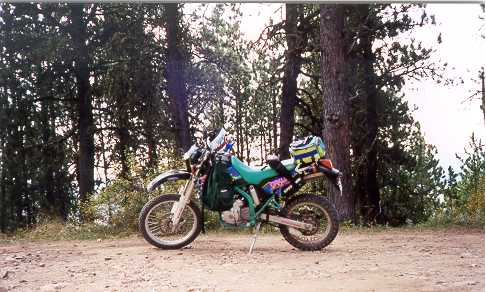
| Apparently this was a relatively warm morning (Fall 1988), preparing to ride to school. I hadn't yet discovered the wonderful world of backpacks, so sports bags and bungee cords were my best friends. The band geek that I was, some days I would strap a saxophone case to the seat. If you're wondering why Suzuki built these bikes with a European flavor (exhaust on the left; drive chain on the right), note the lettering on the graphics. The photos were developed with the negatives reversed. Yes kids, these pictures were taken in the old days, when we waited patiently for photos to be developed, only to discover half of them were taken without removing the lens cap. The top photo was taken in 1997 during a trip to Montana, where my faithful SP200 saw the last of its best riding days. The bike was perfect for the wide open spaces of Eastern Montana, as its range on a single tank of gas was over 200 miles. Later in that same trip I took the SP to the Black Hills region of South Dakota, where its lean street jetting and stifled airbox were no match for the thin air at 6,000 feet above sea level. The small blue tool bag on the rear fender was the perfect size to store the airbox and the mild-toned exhaust note suddenly became a roar heard all throughout the mountains (those 4-strokes do have a bit of intake noise). The next Spring I sold the SP to Dennis Richard, one of my farm customers where I was employed, during the end of my time in Kankakee, Illinois. I had plans to return to the Black Hills and do some dual sporting in Wyoming the following summer and knew the SP wouldn't cut it. Plus, the bike had traveled more than 10,000 miles in its 10 years and was beginning to show its age. It was a sad day, driving away from Dennis' house without my trusty SP200. |
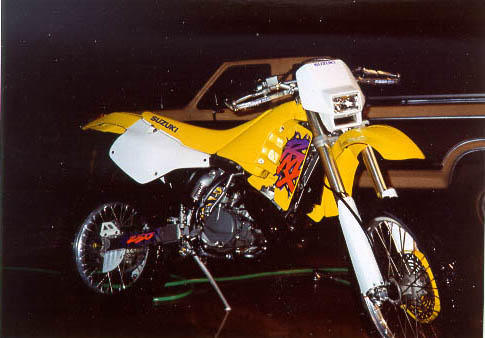
| 1994 Suzuki RMX250 Year purchased: 1993 Year sold: 1995 |
| Throughout most of high school and college, I had my mind set on eventually trying my hand at racing hare scrambles and enduros. To do this, two things had to happen: 1) I needed to be living on my own, away from my disapproving mother; 2) I needed a race-worthy motorcycle. In the early 1990's Suzuki had developed an RM250-based off-road racer designated as the RMX250. It was an overly EPA-friendly 2-stroke, which meant in stock form the bikes were terribly tame in the woods. However, a few modifications, mostly to the exhaust and airbox, could turn them in to very capable racers. My Suzuki theme continued with the purchase of a new 1994 RMX250. The RMX was a great bike on which to learn the art of woods riding. As a rider's abilities grew, so could the engine's power output. The first modifications most racers performed were removing the heavily restricting airbox cover and snorkel, which channeled a very small path for air to enter the carburetor. Next came an aftermarket pipe and silencer to shed some weight and uncork the exhaust flow. From there it was a few minor jetting changes and, like magic, the RMX could be competitive in any woods racing environment. All it took was a decent rider, which I was not. I was also not a good mechanic, so the bike served as a learning tool for basic repairs and maintenance of a dirt bike. As shown in the photo above, I hadn't figured out how to properly mount hand guards. My first hare scramble was on this bike in 1994, as was my first trip to Michigan and my first attempt at an enduro. Just before I traded the RMX for a newer version, the shock blew a seal and I rode half the Turkey Creek Enduro with no damping whatsoever. Naturally, I had no idea. My focus was on keeping the wheels connected with the trail - what went on with the motorcycle underneath me was very secondary at that point. |
| 1996 Suzuki RMX250 Year purchased: 1995 Year sold: 1998 |
| The 1996 version of the RMX250 finally received some much-needed updates, most notably the conventional forks. The rest of the chassis was mostly unchanged, but the engine was given a few minor updates that resulted in a bit more power out of the crate. Even so, it was still under-powered and needed the same exhaust, airbox and jetting modifications. The suspension was a huge improvement, front and rear, with the forks super plush and the rear end stiffened somewhat. One thing I always enjoyed about the RMX's was grease zerks on the shock linkage and a buttery-smooth clutch. To this day, I've never owned a bike with a cable-operated clutch that had a lighter pull than either of those two bikes. The transmissions were also exceptionally smooth in shifting. The '96 RMX was another good "learner" bike, especially when I seized up the engine at a mud race in Canton, Illinois early in 1996. The local Suzuki dealer sent the engine to be re-sleeved with an iron bore, which I later discovered is not the preferred method for fixing an electro-plated cylinder. Even after sending the engine away a second time to install an aluminum bore and new electro-plating, I never could get the jetting sorted out. It became someone else's problem when I traded it for a KTM 300EXC. |
| 1993 Kawasaki KLX650-C Year purchased: 1998 Year sold: 2001 |
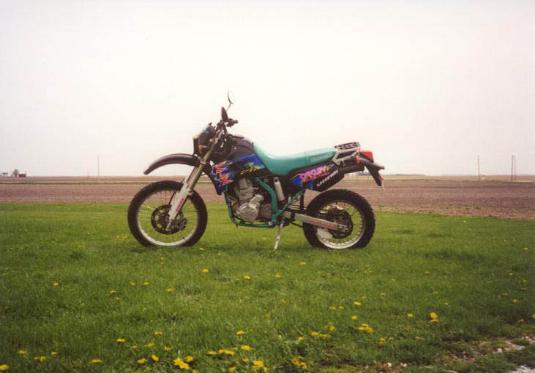
| I picked up this bike in 1998 after selling the SP200. What a large, heavy motorcycle. The dual sport version of the KLX was apparently supposed to be a more dirt-worthy version of Kawasaki's KRL650, as it was loosely based on the dirt-only KLX650R. With a 650cc single cylinder engine, it made decent power for street and dirt road use. Despite its long-travel suspension, you didn't want to let the wheels leave the ground. Fully loaded, this was a 375-lb motorcycle with very soft springs - especially the rear. And despite its appearance, the shock was not adjustable. Kawasaki engineers devised a creative use for the empty space left where the nitrogen reservoir was located on the dirt-only KLX650R: a fake plastic nitrogen reservoir, hollow in the center and a perfect size for a tool kit. In 1998 I took the KLX to Wyoming and had a great time in the mountains. The engine barely missed a beat in the altitude and the smooth ride was good for dirt and gravel roads. I probably would have kept this bike longer, but city living was less than suitable for a dual sport motorcycle. Bikes like this deserve to live in the country. |
| 1999 KTM 300EXC Year purchased: 1998 Year sold: 2003 |

| In 1998, I'd moved to St. Louis and was experiencing the offroad scene in Missouri. With that, I stepped into the serious world of racing with the KTM 300EXC. And within 6 months of owning it, I'd broken about everything on it except the engine, transmission and suspension. You name it, I broke it. Notice the difference between the above photo, on the day I brought it home, and the picture below when I sold it: |

| Let see, where do I begin...bent both brake rotors, cracked the rear hub (note the shiny gold Talon hub), bent both triple clamps, bent handlebars, smashed pipe, and that horrible lower shock bearing.... Once all those parts were replaced with aftermarket equivalents (except the lower shock bearing), I had very few additional breakages. The engine never let me down, the power delivery was exceptional and the massive 50mm WP forks were the plushest on earth. The linkage-less shock wasn't quite as good as the Suzuki's I'd owned prior, but its virtual maintenance-free operation almost made up for it After 4 years and more than 250 hours of riding and racing, I sold the 300EXC and bought a 2002 KTM 300MXC. |
| 2003 Kawasaki KX250 Year purchased: 2003 Year sold: 2006 |

| The 2003 KX250 was a host of "firsts" for me: first pure-motocross bike, first bike ever received in a crate, first conversion of a motocross bike into a woods bike. The latter "first" was the most challenging, but absolutely necessary, for a motocross bike in the woods is not my version of nirvana. By this time in my offroading "career", my mechanical skills and knowledge were adequate to get the woods conversion done, but it was still a bit of an adventure and plenty of work. The aftermarket is full of everything needed to make a motocross bike work well in the woods, but it seemed that every modification required some massaging to fit and/or work correctly. Once it was all done, the KX worked pretty well in the woods. In comparison to the woods-designated KTM's and RMX's, the KX250 was a different breed. Even with extra flywheel weight, a motocross bike still has a different powerband. I had to learn to ride more aggressively, keep the rear wheel spinning and charge into the trails. After W.E.R. Racing reworked the suspension, it was as good as anything I've owned. After 2 years of hard riding, I sold the '03 KX250 and bought another KX250, this time a 2004 model. |
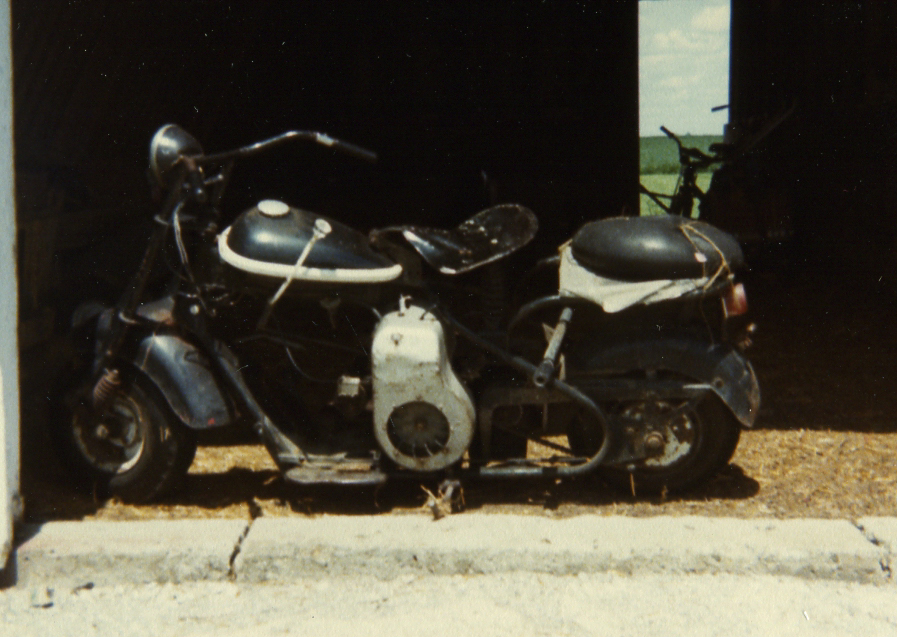
| Here's the motorcycle responsible for my passion: my dad's mid-1950's Cushman scooter. This photo was taken in the early 1980's. At the time, it still ran, albeit without its original engine. The passenger seat was an old inner tube - note the twine holding it to the frame. The Cushman still survives on the farm. |

| Here's another one from the distant past. This was my cousin Rhoda's minibike back in the late 1970's. The Roadster with the Rupp engine will see new life in 2007, as another generation of kids will get to ride it around the farm and burn their legs on the exhaust pipe. |

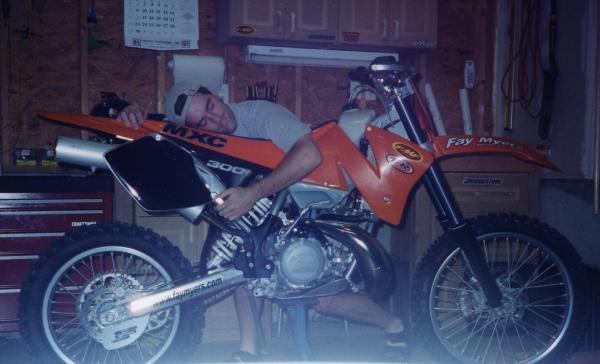
| The KTM 300MXC was the first of several new bikes sourced from the Internet. This one came from Fay Myers in Denver, with help from eBay. I was living in St. Louis at the time and made the long drive across I-70 to pick up the bike in July 2002. Thanks in part to smaller forks, the 300MXC lost some weight in comparison to the 300EXC. Wheelies were a breeze. The MXC was my first bike with motocross-style transmission gearing, which I came to prefer for woods riding. Top speed was a bit lower and I often had difficulty in keeping up with bikes having wide-ratio transmissions, but overall the bike was a pretty good woods weapon. |

| 2003 Gas Gas 300EC Year purchased: 2007 Year sold: 2010 |
| The Gas Gas came to me in the form of a too-good-to-pass-up offer from an old Missouri riding buddy, who gave me a chance to own a bike I planned to use exclusively for enduros. At the time, I still had my 300MXC for this purpose, but it was showing its age and I knew the 300EC had considerably less use. Plus, the 'Gassers were always intriguing to me, with their high quality parts and smooth power bands. This remains the only racing dirt bike I've ever been able to obtain a street license plate for. Having that plate made it a little easier to pass enduro inspections. Oddly enough, the front forks were the same WP 43mm versions as the 300MXC, but they were tuned remarkably plush. Why KTM chose to set up their forks so harshly, I'll never understand. I sold this bike after my 2009 KTM 250XC proved to be the ultimate all-around machine. I no longer felt the need to have specific bikes for hare scrambles and enduros. |
| 2004 Kawasaki KX250 Year purchased: 2005 Year sold: 2010 |

| As the motocross world embraced 4-stroke dirt bikes, the 2-strokers received less and less R&D, and could thus be bought fairly reasonably. I picked up this '04 version of the KX250 by way of eBay, from a dealer in Fort Dodge, Iowa. The bike was a new, leftover on the showroom floor in 2005. The conversion from MX to off-road was a lot easier this time, since the '03 and '04 models shared mostly the same parts. Other than a different rear wheel, different cable routing to the front brake caliper, and some minor tweaking to the power valve, this was about the same bike as the '03 version. This bike saw probably the largest diversity in racing geography and terrain, with trips to New York, Tennessee, and most of the states contiguous to Illinois. |

| 2009 KTM 250XC Year purchased: 2009 Year sold: 2018 |
| When all but one of the Japanese manufacturers dropped their 250cc two-stroke models, I didn't have too many options when it came time for a new bike. I was still loving on the 2-strokes. Yamaha had the YZ250, but wasn't putting much effort into it. KTM had stepped up their game and was putting out some very specific purpose-built machines. I had been told the XC line would be closest to the KX-style power I had grown to love. Also, KTM had just started putting electric starting on their 2-stroke models. This was enough to convince me to give KTM a try again. I was amazed at the refinement of this bike. What had been lacking in the previous two KTM's I'd owned was totally fixed in the 250XC. Great brakes, perfect jetting, and quality components. I had one minor mechanical issue with the power valve, and years later the electric starter had to be rebuilt. That was it. Of course, the seat was still rock-hard, and the suspension was quite a bit stiffer than I had been used to. But the seat was easily fixable, and I got used to the suspension pretty quickly. It was actually a nice on the motocross track - a true do-it-all bike. After a few months of riding, I knew there'd be no reason to have any other bikes in the garage. I did just about every kind of riding on this bike. I even bought a set of studded tires and rode a few hundred miles in the snow one winter. Eventually, age caught up with the bike, and I just didn't have the time to maintain it like it needed. But this was a great bike. |

| 2016 KTM 350 XC-F Year purchased: 2016 Year sold: 2020 |
| This was the bike that, for a brief period, drew me into the fuel-injected 4-stroke world. The 350 XC-F had its roots in motocross and was modified for off-road purposes. Like my 250XC before it, the suspension was a bit stiffer and the engine was tuned for fast riders. By the time I bought the bike, my stage in life was not as well suited for such an aggressive bike. And as a 4-stroke, I found it more difficult to ride in the tight woods that I enjoy so much. The engine was also significantly more complex than the 2-strokes I'd raced up to this point. And the stalling...only an expensive Rekluse clutch truly solved that problem. The 350 was an interesting experiment, but I had no problem ending it. Guess I'm just a 2-stroke kind of guy. |