
| Pecatonica Airport |
The Pecatonica airport was a grass landing strip at the
corner of Pecatonica Road and Blair Road, just north of
Pecatonica, Illinois. The airport operated a 2,300-foot
grass runway on approximately 100 acres, from the
1940s until at least the 1970s. William Harris, his cousin
Roy Neely, and Leroy Berkebile operated the airport for
many years, providing flight instruction, airplane rentals
and crop dusting services.
corner of Pecatonica Road and Blair Road, just north of
Pecatonica, Illinois. The airport operated a 2,300-foot
grass runway on approximately 100 acres, from the
1940s until at least the 1970s. William Harris, his cousin
Roy Neely, and Leroy Berkebile operated the airport for
many years, providing flight instruction, airplane rentals
and crop dusting services.
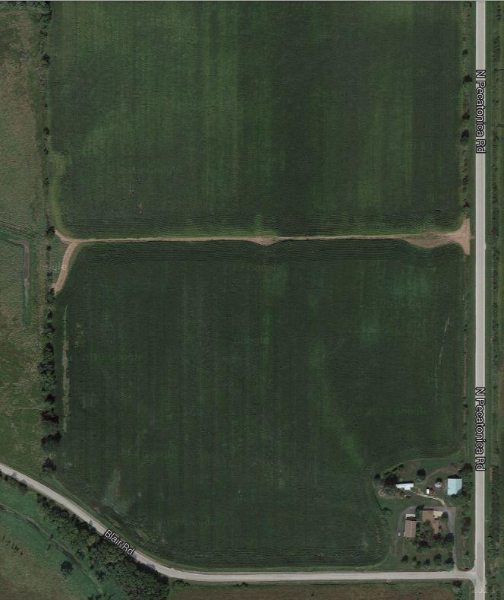
| Technically the Pecatonica Airport still exists, at least in the Winnebago County real estate records. A residence has replaced the hangars, and only the silver-roofed building remains. The airport property was about one-half mile long and about 1,800 feet wide (Google Maps image, 2014). |
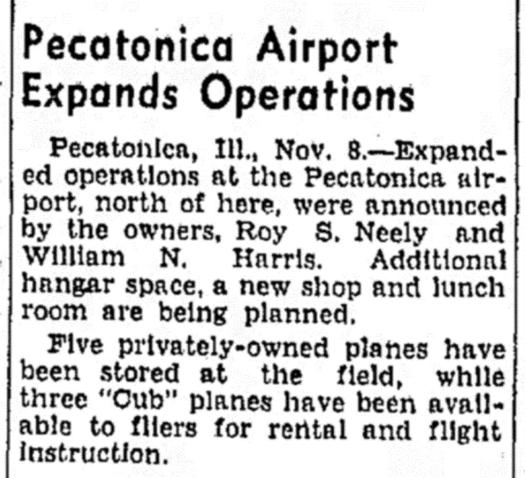
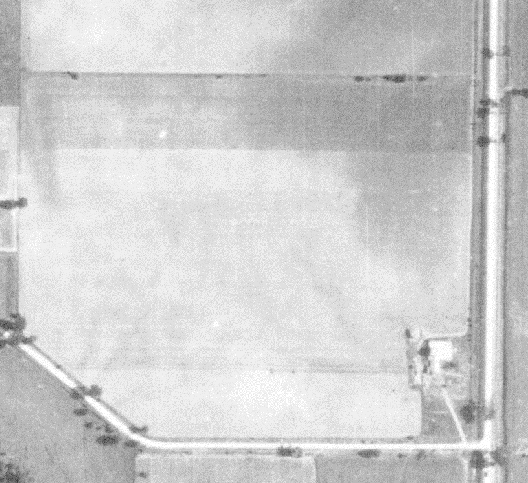
| Above Left: This aerial photo was taken in 1939 as part of the USDA's project to photograph the Midwest from the air. The airport facilities are on the bottom right of the photo, and they don't look like much. But after the war, the airport would expand to meet the needs of the local community. Above Right: In 1945, World War II ended and in November of that year, the Freeport Journal- Standard reported that the Pecatonica Airport was expanding. Three years later, the airport was home to at least 30 airplanes. |
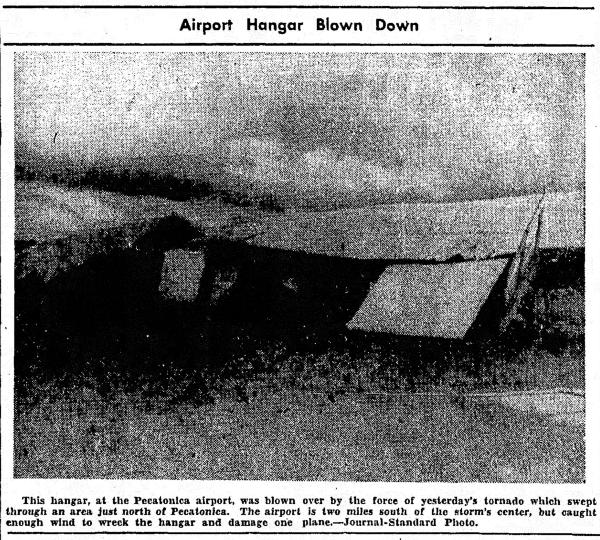
| The Pecatonica Airport owners were probably glad to see 1948 go. Before the fire in November, high winds took down a hangar. The July 23, 1948 edition of the Freeport Journal-Standard reported on a hangar that was blown over after a tornado passed through the Pecatonica area. |
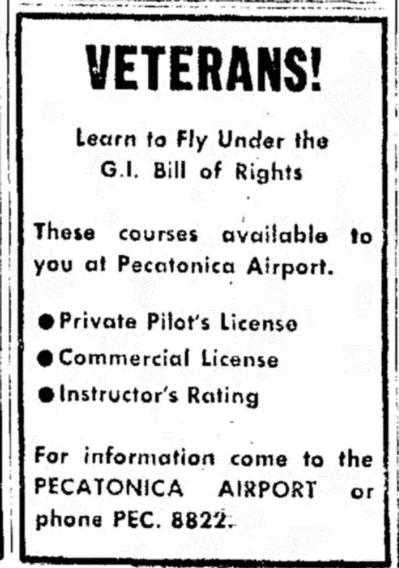
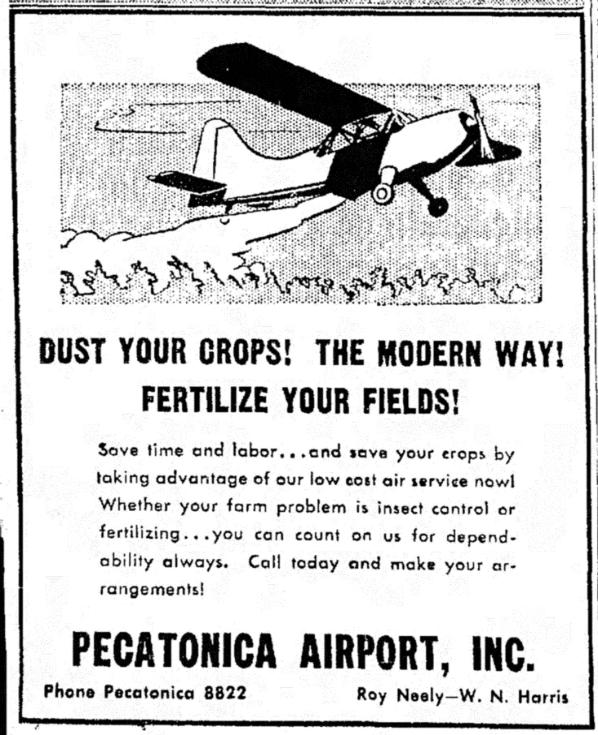
| Left: The GI Bill following World War II provided flight instruction for veterans. William "Neely" Harris trained many of them in Piper Cubs. In his 2009 obituary, he is said to have had as many as 75 students at one time. This advertisement appeared in the Freeport Journal- Standard in the late 1940s. In 1946, two 1939 Piper J-3's at the airport were listed for sale in Flying Magazine. For a |
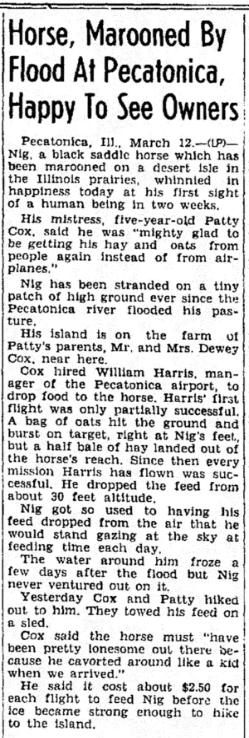
| Above Right: During the year of the tornado and fire, Pecatonica Airport advertised the crop dusting company operated by its owners. By this time the Canner's Aerial Dusting Service maintained a fleet of 18 aircraft. Many of these were Piper Cubs that were modified for spraying fields. The planes sprayed for aphids on many acres of peas grown for the Keene-Belvidere Canning Company. Crop dusting was also about the only way to protect corn against corn borer worms, which weakened the stalks when the corn was too tall to apply pesticides with ground application equipment. Canner's Aerial Dusting Service was among the first crop dusting companies to spray for corn borers in the 1940s. Above Left: The airport made national news in March of 1948, by way of a horse with an unfortunate name. The lowlands around the Pecatonica River are prone to flooding, especially when snow melts in the spring. So it is no surprise that an animal would find itself stranded on an island in early March. This version of the story appeared in the Freeport Journal-Standard, but many other newspapers around the country picked it up on the national news wire. |
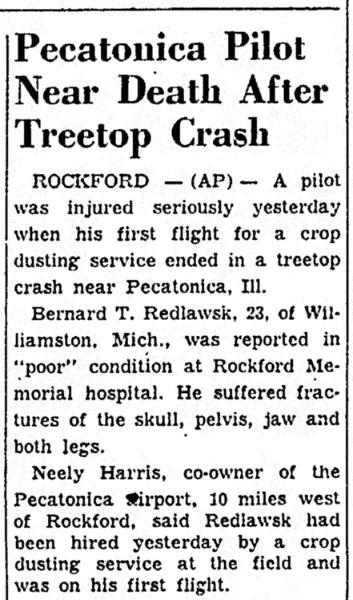

| Above Left: Canner's Aerial Dusting Service made news in June of 1946 when one of its planes was the first in Iowa to apply insecticide for European corn borer. The Wessels Living History Farm has an excellent description of crop dusting in the 1940s. As mentioned in their article, genetically modified corn has mostly put an end to crop dusting for European corn borer. Above Right: Bernard Redlawsk was one of many crop duster pilots who found trouble with inanimate objects. He apparently survived this crash in May of 1952 and lived until 2009. |
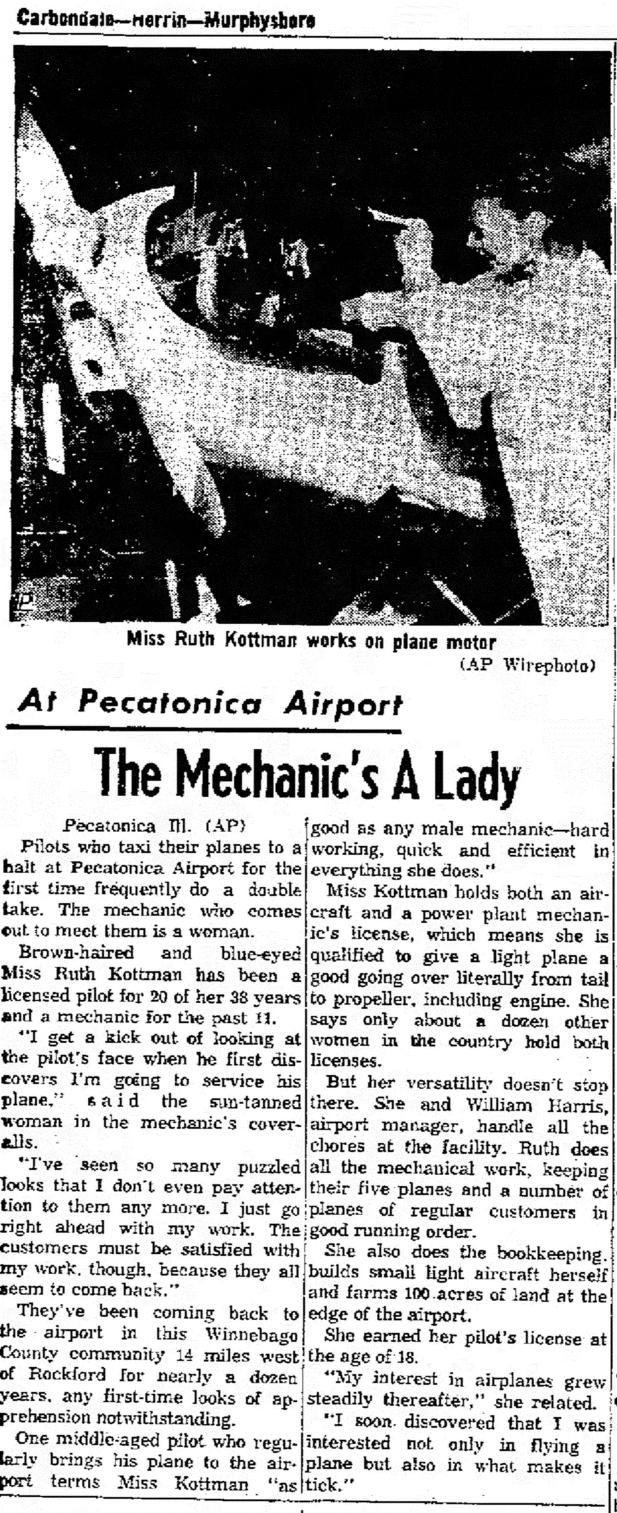
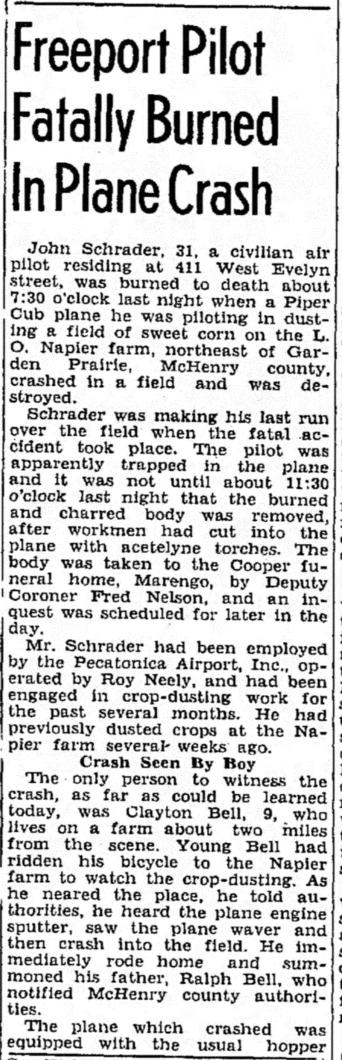
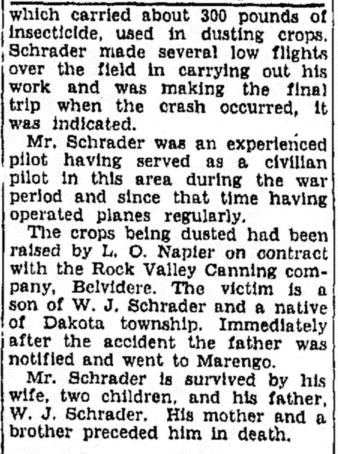
| Below Left: John Schrader was employed by Canner's Aerial Dusting Service when he was killed while spraying a field in September 1947. Below Right: In 1961, Ruth Kottman received national attention when her story was published by the Associated Press. In 1964, the future Mrs. Jack Garr was said to be one of only 5 women airplane mechanics in the United States. |
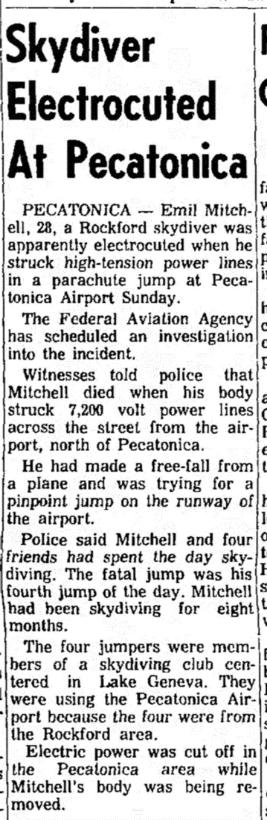
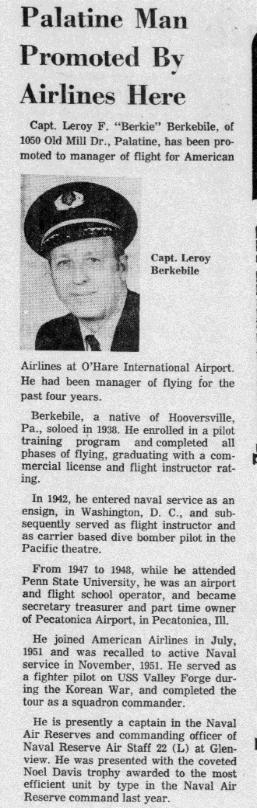
| Below Left: Tragedy struck the airport in 1967, when a skydiver was electrocuted while attempting a landing on the runway. Below Right: Leroy Berkebile was one of the owners of Pecatonica Airport over the years. In June of 1972, he piloted American Airlines flight 119 out of St. Louis, which was hijacked by Martin J. McNalley. |
| This was the last of the articles I could locate for the Pecatonica Airport, and I can only assume the airport did not last much longer. |
The airport made news several times throughout its history, mainly from incidents
of fire and tornado damage, and mishaps from its crop dusting service and
skydiving. But the national press occasionally picked up some interesting, positive
stories that are highlighted here.
The airport grew after World War II, when new hangar space was added to
accommodate the growth of the crop dusting industry and flight instruction for war
veterans. The airport offered Piper Cubs for flight instruction and rental. Crop
dusting took off in the 1930s, and over the years the airport owners' aerial spraying
company covered many acres of vegetable fields with insecticides.
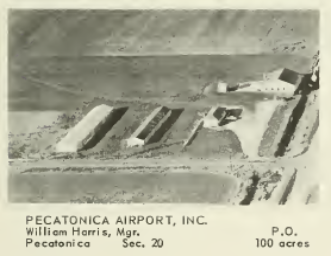
Above is photo of the airport as it appeared in This is Winnebago County (John
Drury, 1955).
of fire and tornado damage, and mishaps from its crop dusting service and
skydiving. But the national press occasionally picked up some interesting, positive
stories that are highlighted here.
The airport grew after World War II, when new hangar space was added to
accommodate the growth of the crop dusting industry and flight instruction for war
veterans. The airport offered Piper Cubs for flight instruction and rental. Crop
dusting took off in the 1930s, and over the years the airport owners' aerial spraying
company covered many acres of vegetable fields with insecticides.
Above is photo of the airport as it appeared in This is Winnebago County (John
Drury, 1955).
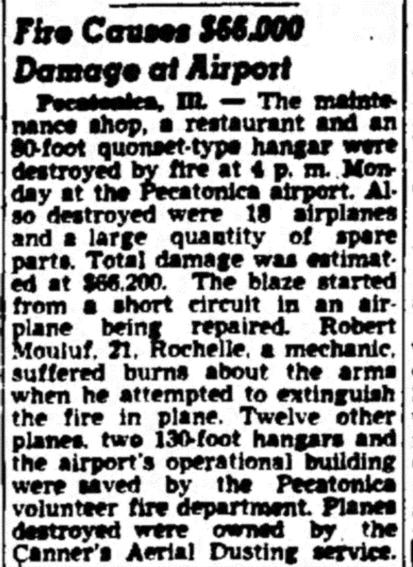
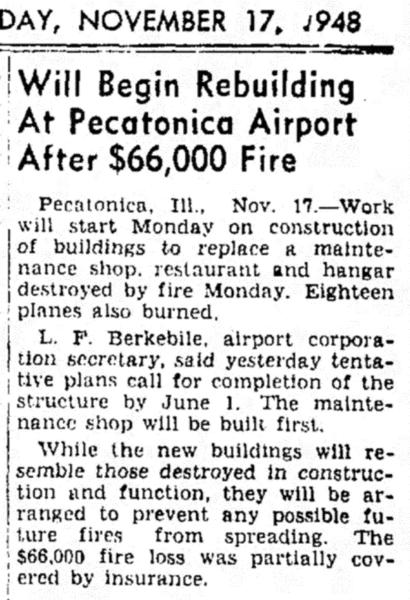
| modest $1,400 investment, an 1800-hour Cub could have made a new home with a pilot who didn't want to fly very fast. Above Right: The November 16, 1948 edition of the Janesville (WI) Daily Gazette reported a disastrous fire at the airport. The crop dusting service took the worst of it. Roy Neely and two other partners incorporated their crop dusting company in 1945 as Canner's Aerial Dusting Service, which did work for the Keene-Belvidere Canning Company in Belvidere, Illinois (now operated by Green Giant, a division of General Mills). Just two months later, the airport was at least partially back in business. In January 1949, the restaurant reopened under the management of Glen Mullican. The Freeport Journal-Standard reported that the restaurant seated 32 and was built with "the latest styles in equipment and fixtures." |
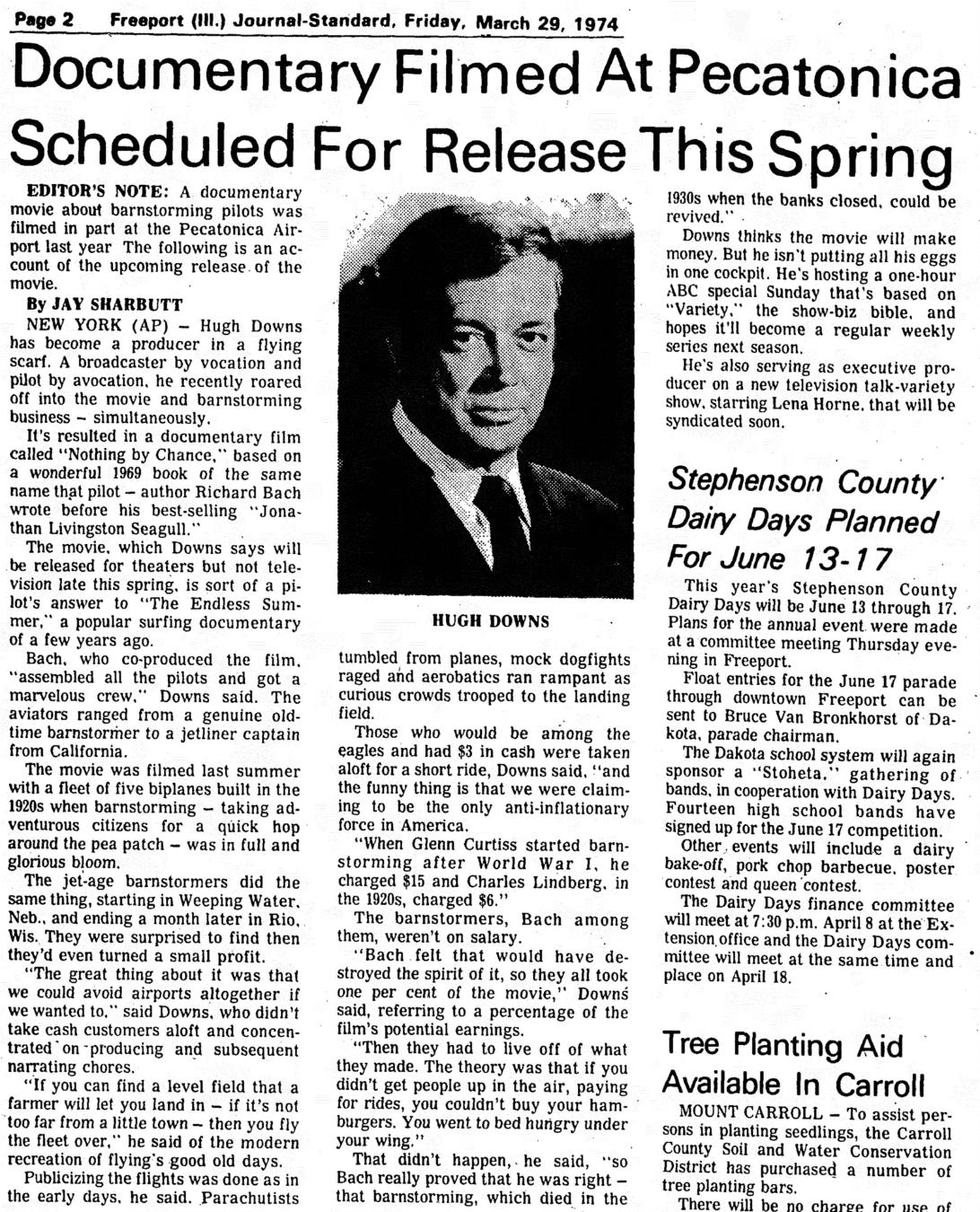
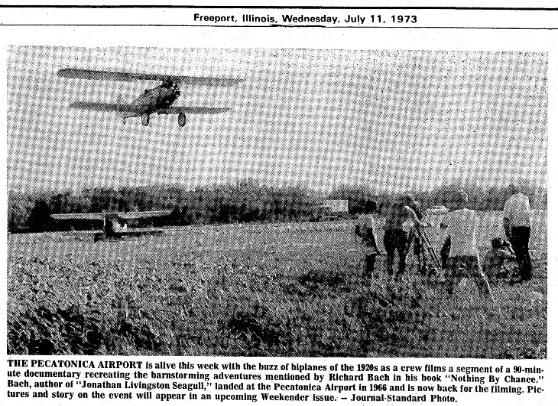
| Below: The airport's claim to fame was being part of a barnstorming documentary in 1974. A youthful Hugh Downs produced the film Nothing by Chance in the style of Bruce Brown's Endless Summer and On Any Sunday. The documentary was a recreation of Richard Bach's book of the same name. One of the highlights of the documentary for Pecatonica locals surely must have been Hugh Downs playing banjo with the "Nothing By Chance Orchestra" under the stars at the airport. |