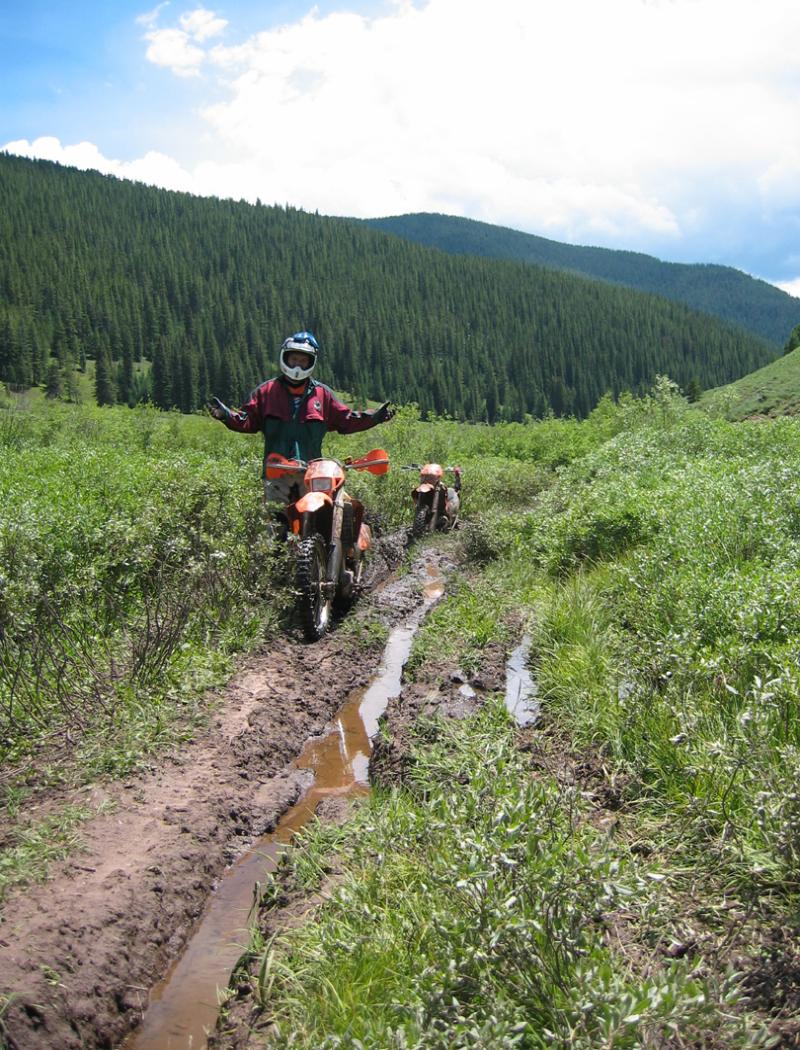
| St. Joe State Park Park Hills, Missouri Phone: (573) 431-1069 Daily Use Fee: $5 Directions: Check out www.mostateparks.com/stjoe/map.htm Main web address: www.mostateparks.com/stjoe.htm Here's how the park is described on the web site: "St. Joe State Park is located in the heart of the old "Lead Belt" of southeast Missouri where much of the nation's lead ore was extracted for more than a century. In 1972, the St. Joe Minerals Corp. ceased operations and subsequently donated the land to the state in 1976. Today, the 8,238-acre St. Joe State Park is Missouri's third largest state park, with approximately 2,000 acres set aside for the state's premier off-road vehicle (ORV) riding area. Contact the park office for more information about the special rules and regulations that apply. The park also features two campgrounds capable of accommodating campers with ORVs and horses, a hiking/bicycling trail, equestrian trails, picnic sites and lakes for swimming and fishing. Visitors can explore several thousand acres of woodlands or spend their days relaxing in the great outdoors. The historic mill buildings, where St. Joe Minerals once processed the lead ore, still stand nearby and have been designated as the Missouri Mines State Historic Site. There you can enjoy an excellent mining museum featuring a large collection of geological specimens and antique mining and milling equipment." Now, here's the dirt biker's perspective. St. Joe State Park consists varying terrain that includes rocks, sand, a little mud, and more rocks. This park is open just about year-round (they close for a couple of major holidays). The $5 daily use fee is a bargain, and year-round passes are available. The camp site has trails that lead directly to the off-road area. All types of off-road vehicles are allowed to ride, so you can expect to see many types of motorcycles, ATV's, dune buggies, and trucks. At the main staging area is a lake that is set up for swimming, so after a hot summer day of riding you can cool off. After the lead mining years ago, what's left is a large, open sand flat surrounded by woods on three sides. An outer trail defines the boundaries of the park (along with some metal highway-style guardrails), and you're free to roam around the established trails within those boundaries. Traffic is two-way, so everyone must be alert for oncoming vehicles. Four-wheeled vehicles are required to have a flag that can be purchased at park's main gate. When I ride at St. Joe, I spend most of my time in the woods and try to stay on the less-traveled trails. If you look closely, there are many single-track trails left over from the 2-3 races held there each year. I used to ride at St. Joe very regularly when I lived in St. Louis, and each time I was there I found a little something new. As with most of Missouri, rocks are aplenty, so use an older medium-to-hard terrain tire if you can. The one advantage of St. Joe's rocky nature is that even after heavy rains, almost everything is rideable. I've ridden there when the trails were literally waterfalls and it was still very fun. St. Joe has something for everyone, but use caution with the younger riders. The open sand flats are where the ATV's spend most of their time, and speeds can be pretty high. Also, the smallest mini-bikes will struggle with the loose sand that has to be ridden over to reach the harder-packed open areas near the back side of the park. The park is actually much larger than the public area in which off-road vehicles are allowed to ride. Several thousand acres are only open when races are held, which is usually three times each year. The annual enduro, held in April or May, covers both the public area and the rest of the park. The hare scrambles are usually held on just the non-public part of the park. Since 2001, St. Joe has hosted a number of AMA National Hare Scrambles and Enduros, as well as International Six Days Enduro ("ISDE") qualifier races. Finger Lakes State Park Columbia, Missouri Route 7, 1505 E. Peabody Road Columbia, MO 65202 (573) 443-5315 10 miles north of Columbia, off U.S. 63 in Boone County Daily Use Fee: $3 Main web address: www.mostateparks.com/fingerlakes.htm Finger Lakes State Park is owned and maintained by the Missouri Department of Natural Resources. This land was a strip mine years ago, so the terrain is full of steep ridges. The park has fewer rocks but more mud than most places you'll encounter in Missouri. This is more of a summertime place to ride. Also in the park is a motocross track where guys like me can attempt to improve their horrible motocross skills on jumps that no spode should be attempting. Finger Lakes was at one time a regular stop on the Missouri Hare Scrambles Championship series. Mark Twain National Forest Chadwick, Missouri From Chadwick, MO, take Hwy 125 south 1.5 miles to Hwy H; turn west to Camp Ridge Recreation Area or continue to Forest Road 171 to Cobb Ridge Recreation Area. For info, call the Ava Ranger District at (417) 683-4428. This part of the Mark Twain National Forest is open to off-road vehicle use. Since it is a national forest, a spark arrestor is required. Also, a permit is needed and they can be purchased at Kay's Store in Chadwick. Expect to see plenty of rocks, since it is Missouri. The Chadwick rocks are a little different, however, with sharp edges and rock ledges. The rock ledges are extremely slippery when wet, so be careful. The trails are all set up as loops, making it fairly easy to find your way back to the setup areas. One interesting feature of Chadwick is that certain parts of some trails are paved with interlocking bricks. The forest service tries to control erosion this way, but as with the rock ledges, the paved brick can get very slippery when wet. Getting up the steep hills while spinning your tire on slick concrete can be a challenge. Most of the trails are two-track ATV style, which means that speeds can get fast. The forest service does not like trail blazers, so stick to what's already there (I didn't dare stray - there's so much acreage that I feared getting lost). Be prepared for pinch flats!! Fox Valley Offroad Wedron, Illinois Directions: see website Operated by Gerhard "Wardy" Ward, Fox Valley is riding park near Ottawa in North Central Illinois. Motorcycles and ATV's are welcome at Fox Valley, so expect to see relatively wide, established trails. When wet, the trails are slick and you'll find a few deep ruts. Dry trails are hard packed and sometimes a bit rough. The property has a few steep hills, a kids motocross track and a second track for the big bikes. Cost to ride is $20 per day. Michigan Trail Network Some call it the largest state-maintained trail network in the U.S. I call it singletrack Nirvana. If you like riding in the woods, Michigan is the best place I've ever seen. I've ridden the upper and lower peninsulas, and all trails have one thing in common: sand. Some trails are sandier than others, but definitely put on some soft-terrain tires if you make the trip. Detailed maps are available from the Michigan Department of Natural Resources, as are OHV permits which must be obtained to ride legally on the trails. The DNR maintains singletrack and ATV trails, and the best part is that the 4-wheelers are not allowed on the singletrack. The trails are pretty well established and have some sizeable whoops in many places. Since they are designed with conservation in mind, don't expect to see too many steep hills. But if it's singletrack you want, you'll get it in Michigan. Taylor Park Gunnison County, Colorado Scenery, rocks and challenging trails make up the Taylor-area motorcycle and ATV trails. It's a fantastic experience. The best place to set up for a week of riding is the Taylor Park Trading Post, which has all the gear and maps you'll need. Several campsites are available within a few miles of the Trading Post if you want to rough it. If you want to be a little closer to civilization but still close to the trail network, try Three Rivers Resort just north of Gunnison. ATV's are more common than motorcycles, but the trails are set up for both singletrack and 4-wheelers. Elevations are anywhere from 8,000-13,000 feet, so jetting changes are pretty much a requirement. The first and best thing to do upon arrival is to buy a large fold-up map at the Trading Post which uses a type of paper that can get wet without getting destroyed. This is important, because you'll almost certainly need to consult the map often and during the summer it rains almost every day in the afternoon. The rains aren't usually too heavy rain and don't last long, but do expect to get wet and dress accordingly. At those elevations, you'll probably not get too hot and at night it can get downright frigid (was in the mid-30's every night we were there in July 2006, at the Dinner Station campground north of Taylor Park). I wore a riding jacket pretty much every day. In 2007, temperatures were warmer and the trails were mostly dry. If you ride before or after July/August, the higher elevations will have some snow. For me, the times I've been there were truly a vacation - no cell phone signal and no Blackberry service. The terrain is very rocky and hills can get steep - after all, you're riding in mountains. Some trails can be very dangerous, especially the ones carved on the side of mountains. If you're above the tree line, one mistake could leave you sliding hundreds of feet down the side of a mountain with nothing to stop you. Same goes for mountainside trails in the woods, except tress will stop you slide - eventually. Bring a first aid kit, too. Civilization can be spread pretty thin. White Rock Recreational Area Ozark National Forest (Arkansas) Think St. Joe State Park times 10. This place is huge. I did a 65-mile enduro here in 2004 and saw maybe 1/3 of the trails. Located east of Fayetteville, the terrain is rocky and the elevation changes are plus or minus 500 feet. The hills you climb seem to go on forever, as do the downhills. This area hosts some downhill mountain bike races, if that gives you any idea of the size of the mini-mountains. Many of the trails are wide enough for ATV's but the locals know where the good singletrack is. But be careful: you can get lost in there - just ask Brian Jahelka. The annual White Rock Enduro is held here and is a fun, first-class event. For more info on where to pick up the trails, check out the USDA Forest Service website. |
| Trail Riding in the Midwest and Beyond |
For anyone who's ever asked the question "Where can I ride", here is an abbreviated answer:
These locations are all public trail riding areas where I hone my riding skills (or lack thereof). If
you want a brief synopsis, click here for a quick summary of conditions of these riding areas.
These locations are all public trail riding areas where I hone my riding skills (or lack thereof). If
you want a brief synopsis, click here for a quick summary of conditions of these riding areas.