|  |  |
turn your gas on before the race or your bike just may not start." -- Pat Garrahan in his 2004 Elkton, Oregon
national hare scramble race report.
Westphalia, Missouri
11th of 14 in A Sportsman
First, let me state what to some may already be obvious: I am an idiot. A certified fool. I would
like to say that forgetting to turn on the gas is a once-in-a-lifetime occurrence for me at a
race, but as we saw last year at Warrensburg, that is not the case. I rode my KX250 from my
truck to the starting line and used just enough gas to drain the carburetor. When the 15-
second board dropped, the other riders vaulted forward and I had nothing. A guy next to me
on a 4-stroke had to give his engine several kicks but eventually he, too, left me on the line. I
glanced down, viewed the petcock in its “Off” position and felt the same kind of dread that
happens when you try squeezing out that last bit of gas at the end of a race, hear the engine
sputtering, and can’t get the petcock switched to “Reserve” before the engine dies. I kicked
over the engine until the 30-second board came out for the Senior class in the row behind
me, then pushed my bike off to the side. The engine finally fired just after the Senior class
took off.
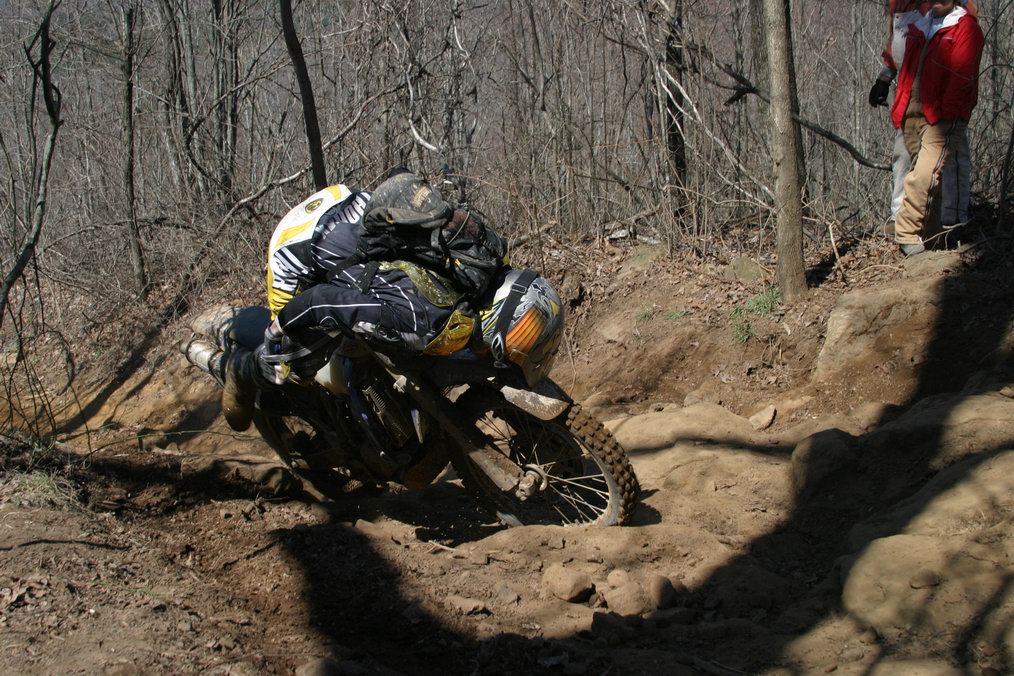
I sprinted into the woods at the back of the Senior class pack and passed many of them within
a few miles. The trails were mostly ATV-wide, so speeds were high. Much of the course
followed the same route as many past races at this venue, causing some extremely choppy
conditions. With my class still far ahead, I tried to ride as aggressively as I could. About
midway through the first lap I caught up to Tom Eidam, then got passed by Open B winner
Dwayne Parish riding with blazing speed through the open trails.
Other than its roughness, the course was in good condition. But the wide open, rugged trails
took their toll on my clutch hand. In the second lap a blister developed on my palm, then
another on my middle finger. Small adjustments to preserve my clutch hand were slowing me
down, but I didn't realize that until after I had finished an uneventful second lap. On the third
lap some of the Senior class guys that I had passed earlier were getting around me, including
Tom Eidam. The blisters were growing as the course became rougher. The short sections of
singletrack were welcome relief, but on the wide trails I just couldn't grip the handlebars well
enough. I began the fourth lap with a left hand that was just plain raw. Each time I pulled in
the clutch lever, I felt pain. At about the halfway point in that lap, I gave up and putted around
the rest of the course, mostly in first gear. I had enough time to do a fifth lap but called it a
day instead.
As much as I like to keep these reports somewhat light and entertaining, I would like to point
out a serious example of what I see as the most concerning problem in our sport. In one of
the open pasture sections, a guy on a 4-stroke passed me with his throttle pretty much wide
open. The noise coming out of that guy’s bike was so mind-numbingly deafening that I could
not even hear my own engine. I had to slow down because my ears hurt. There are many
issues that threaten our riding areas and access to trails, but none will end our riding
privileges more quickly than insanely loud bikes. Think about it...please.
Leadbelt National Enduro
St. Joe State Park (Park Hills, Missouri)
May 23, 2004
7th of 19 in Vet A
It’s not often that I spend six hours straight on a motorcycle, for good reason: it hurts. Past
Leadbelt enduros that I've ridden were a bit more moderate in terms of total mileage, but
when the AMA began scheduling this enduro for its national series, the Missouri Mudders
upped the ante. I had pre-registered on row 5 with Jeff Neathery and the legendary Donnie
Dannar, captured on film (or .jpeg) and made famous at the 2004 White Rock Enduro for his
acrobatic fender kiss on Work Hill. Sadly, Donnie was unable to attend the enduro and left
numerous Leadbelt photographers canvassing the course for alternative photo opportunities.
At the riders meeting, course officials announced that the infamous Waterfall would again be
part of the 50-mile loop. This section drew rave reviews from some of last year’s participants
and gasps of anxiety from others. While the waterfall showed up early in the 2003 Leadbelt
course, this year it would be just a few miles from the end of the loop. So in addition to late-
race exhaustion, riders would have the Waterfall to look forward to.
Even though I arrived in what should have been plenty of time to sign in, pass the sound test
(barely) and get geared up, I managed to fumble around long enough to kill all but about
three minutes of spare time. Jeff was waiting for me at the starting area in the sand flats next
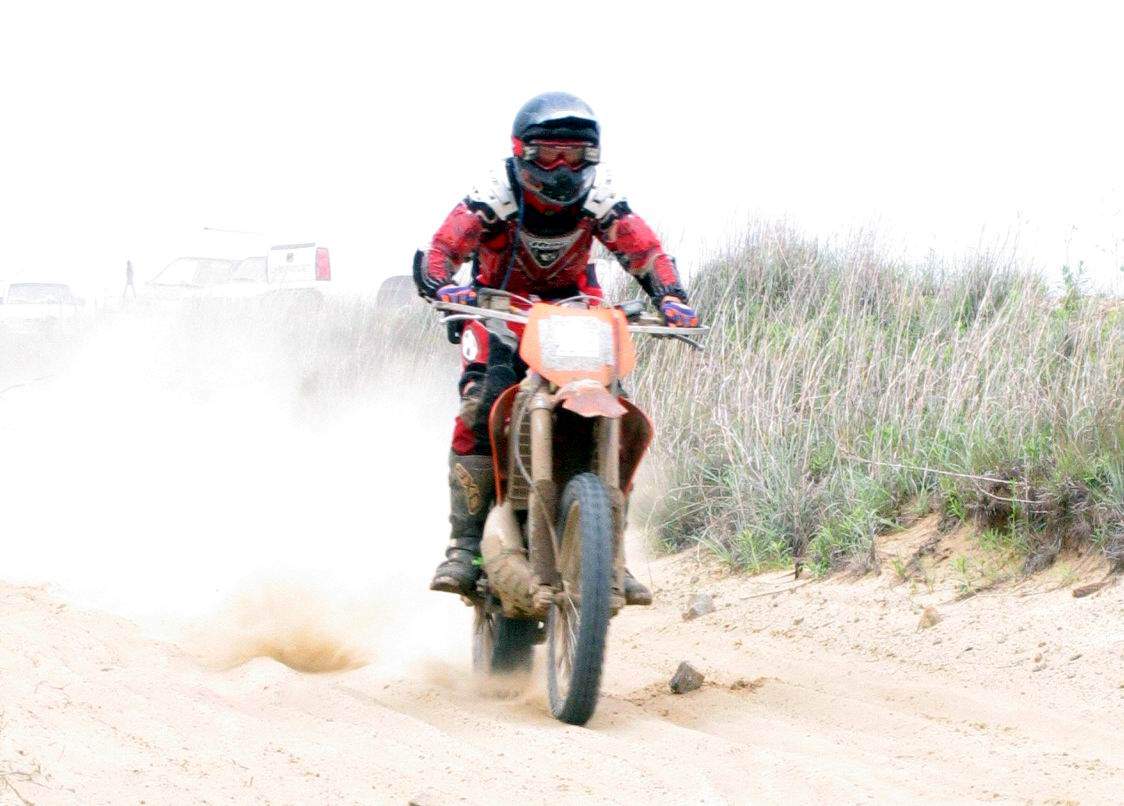
to the pit area. The skies were a bit overcast and the wind was kicking up some sand as the
clock counted down to our minute. We had two other riders with us on our row, and as the
course officials flipped over “5” on the number board, Jeff and I took off first. The beginning
speed average was a leisurely 15 mph as we rode past the pits through the sand. While we
rounded a sweeping corner, my KTM, idle since the White Rock Enduro in March, welcomed
me back into its saddle by locking in on a mound of grass in the sand. As if by magnetic
attraction, the front wheel caught the edge of the mound and buried itself in the sand. Jeff
passed by as I went down, surely wondering how in the heck anyone could fall in the first 200
yards of a 100-mile enduro, during a 15 mph section in open sand. Fortunately for me, the
photographers were unavailable for that photo op.
I caught back up to Jeff in time to take about a one minute break just before the 3-mile mark,
after which we were fair game for checks. The speed average jumped to 18 mph at that point,
where Jeff and I took off again with him leading. The trails were mostly twisty, second gear
stuff that I could tell was going to challenge me to keep on time. Jeff eventually let me lead
and we quickly caught up to a pair of guys in the row ahead of us. One guy let me around
immediately, but the lead rider wouldn't let me pass. After about three yells I lost my patience
and put an MHSC-style block pass on the guy.
The 18-mph speed average increased to 24 mph just after the 8-mile mark, and from there
on it was a sprint to the gas available about 12 miles later. The course was in great shape
after a relatively dry week, and the trails were fairly easy to follow. Much of the first 20 miles
twisted through the non-public area of St. Joe State Park where hare scrambles courses are
typically run. If not for an extremely sensitive rear brake, the ride to the gas available would
have been relatively uneventful. But for the first time in my 5-year history with KTM's, the
300MXC actually solved its own problem. The spark arrestor eventually oozed out enough
spooge to cover the caliper and drip onto the rear brake rotor. After that, the braking action
was fine (who says spooge is a bad thing?). The gas available, 20.6 miles into the race, was
also the location of the first reset. I was a few minutes behind at that point but the reset gave
me enough time to gas up and rest for a short time. Jeff arrived at our gas jugs just a minute
or two after me.
As the clouds began spitting out raindrops, we took off together and began the second
section of the course. These trails meandered through the woods adjacent to a long stretch
of power lines. With many miles of singletrack, this area was the most enjoyable riding of the
day. But a few miles into these densely-canopied woods, the skies darkened and my rose-
tinted goggle lenses made it tough to see. The speed average dropped back to 18 mph
somewhere in this section but I was still running behind. One of the challenges of my old-
school method of timekeeping (clock, roll chart and odometer) is that it’s very hard to read the
roll chart while being bounced around on the trail. Even so, I've competed in enough enduros
over the years to get a feel for the speeds necessary to stay on time without constantly
monitoring the roll chart. Too much 2nd gear in an 18 mph section will make me late, and
that's what I was doing too much of. I knew I needed to go faster.
The trails eventually led us into the public area of the park for the third section of the loop,
where the woods were more open and speeds were faster. These familiar trails should have
helped me get back on time, but the roll chart said otherwise. Near the end of this section we
passed through a brief but very tricky infestation of jagged rocks and ledges that were just
close enough to a lake to envision a wet, premature end to my day. When riding for fun in the
park, it’s a spot I normally try to avoid like a psychotic ex-girlfriend, but on this day I was
forced to deal with it, sort of like when you run into your psychotic ex-girlfriend while with your
current girlfriend and have to be nice when you really want to just push her into the nearest
lake. But I digress. By some miracle I breezed through the rocks and shortly after that was
another check. Following the check was the next reset out in the middle of the St. Joe sand
flats, where I had a couple minutes to catch my breath. I was now about 37 miles into the
enduro. Jeff caught up just before I was ready to get back on the trail and showed me the
blank screen on his Watchdog computer. Now he, too, was an old-school timekeeper.
The last section of the 50-mile loop took us to the west side of the park and outside the public
area. On every even mile there was a piece of white cardboard stapled to a tree, with the
mileages and times printed twice – once with numbers corresponding to the first time around
the loop, and another set for the second go around. At the riders meeting we had been told
the Waterfall would be around mile marker 55 (about 45 ground miles into the loop). As I
approached that point I became just a little bit nervous. Around every corner I expected to
see it. Finally, the trail came to a spot where a second set of arrows pointed to an alternate
route and a guy was planted there directing traffic. This year the signs were labeled more
politically correct with use of the words “Easy” and “Hard” (use your imagination of what the
“Easy” trail was called last year). Choosing the trail marked “Hard” led to the Waterfall and
“Easy” was presumably, well, easier (but longer) than the Waterfall route. I’m always a sucker
for the more challenging option, so I took the hard trail and quickly saw the most intriguing
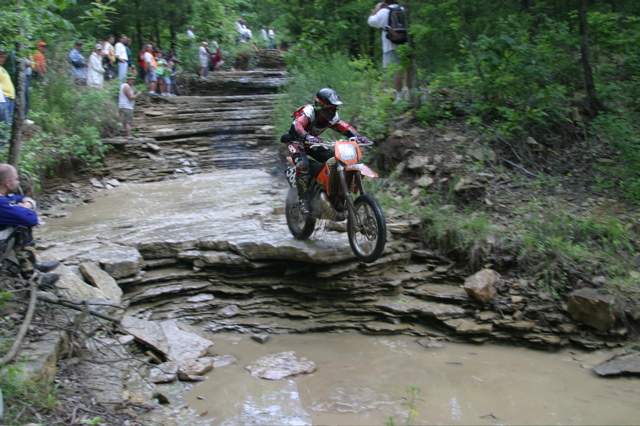
section of trail that I've ever ridden. It ran straight down the center of a creek with a flat rock
bed and dropped 20-30 feet over the next 100 yards. Using my knowledge gained from
Geology 101 (Rocks for Jocks) at the University of Illinois, I would describe these rock
features as: a) flat, pretty much; b) kinda tan colored; c) a bunch of ledge drop-offs. The
creek had a small trickle of water flow and about half a dozen vertical drops ranging from 2-4
feet. Each ledge was just long enough to allow about half a second before having to commit
to launching off the next ledge. The sides of the creek were lined with spectators and
cameras. I pointed the KTM down the center and hit the first couple of smaller drops cleanly.
As cameras flashed, I launched over one drop after another. The two largest drop-offs, both
around 3-4 feet, came last. The first of these high ledges was a straight approach, but the
next one required a quick change in direction to match the contour of the creek. I was able to
jump down both of those ledges without any problems and sighed with relief. A few miles later,
the first loop ended. I had just enough time to gas up and scarf down a sandwich before
heading back out for my second loop.
While the short-course riders relaxed, I began my fourth hour of racing. Strangely, I felt
almost fresh as I rode through the next 20 miles to the gas available. Over the course of 100
miles, it’s sometimes hard to recall any significant details of a particular section, and I
honestly can’t remember anything substantial about the hour or so it took to get to the next
reset. At the gas available, 70 miles into race, I topped off the tank but didn't see Jeff. After
another minute or two of rest, I headed back into the woods just a bit early. As we were
warned at the rider’s meeting, a check appeared quickly. I saw a “4” on the number board
and went into my best sloth mode, hoping that they’d flip the card to “5” and I wouldn't burn
the check. Thankfully, the card was flipped just when I was about to put down my foot.
[editor's note: this may or may not have occurred at this check, but like I said, 100 miles is a
lot of friggin' riding so my memory might be a little off]
When I started my second trip through the nice singletrack, I began to notice my front wheel
sliding around more than it had the first time through. Then I felt the back end sliding around.
In the brief sections where sunlight was reaching the ground, I could see the trails were
definitely damper than on the previous loop. Apparently a small cloudburst had dropped just
enough rain over this area to make things a little slippery. After a few miles of sliding around,
the course was dry again. This section probably separated the fastest riders, as it was all 24
mph versus 18 mph the first time through.
Back in the public area of the park, my knees felt sore. I was about 80 miles into the course
and had been on the bike nearly 5 hours. At one point the trail met up with a very well
established ATV path, where the arrows indicated a sharp left turn onto this path. I overshot
the turn, but the woods were fairly open in this area so I made a gentler turn and rode parallel
to the marked trail until I could find an opening to get back on the arrows. When I found an
opening and swerved left to get back on the trail, I realized I was riding about 5 feet higher
than the ATV path, which had been eroded down several feet after many years of use. In
third gear, there was no time to abort so I flew over the ledge. The drop down onto the trail
was one heck of a jolt, but after that I didn't notice my sore knees anymore.
At the next reset in the middle of the sand flats, I saw no sign of Jeff and assumed he had
encountered a problem somewhere in the second loop. This time the reset gave me only a
minute or so of rest, as the speed average had been 24 mph for all but 11 miles of the
second loop. I was back on the trail quickly to begin the last 12 miles of the race. By now my
body was starting to feel the effects of nearly 90 miles of riding, and I just wanted to get done.
As with the first loop, I anticipated the approaching Waterfall at every corner when my mileage
indicated it was close. There were fewer spectators the second time through but the result
was the same: I made it through smoothly. A few miles later I reached the sand track next to
the entry road that led to the pit area. I was in the home stretch, firmly planted in the seat and
too tired to stand for any length of time. But just before the final checkpoint, I could see a guy
with a camera taking shots of riders as they slowed to cross over the road. I reluctantly stood
up on the pegs to give some semblance of aggressive riding, saw the camera flash and then
flopped back down on the seat.
I ended with a score of 55, good enough for 7th place in the Vet A class. The overall winner
was Steve Hatch with a score of 5. Doing the math, Steve made it to the finish line 9 minutes
sooner than me and had 41 extra minutes of rest during the resets. And that, folks, is why he
gets paid to ride. The Leadbelt was a milestone event for me, as I had never before ridden a
100-mile enduro. Like I said, the reason is simple: it hurts.