|  |  |
Fosterburg, Illinois
1st in A Intermediate
Getting a lot from a little is something the Splinter Creek Dirt Riders do very well. Their club
property near Fosterburg is no more than 80 acres, yet the hare scramble loop laid out for
this race was nearly 5 miles in length. With help from tight, twisty trails and generous use of
the club’s motocross track, the course challenged many riders to complete laps in less than
20 minutes. The day before the race I was given an advance preview, helping friend and club
member Jeff Smith sort out potential trouble spots. The course was a mix of old singletrack
and ATV trails, some freshly cut new trails, and a nearly full run through the motocross track.
In the pits on Sunday morning were several MHSC regulars who had made the trip across the
river. Matt Sellers, Mark Gay and Keith Voss were already set up when I arrived, and John
Yarnell pulled in shortly after I did. A fellow KX250 racer, John had asked me to bring along
my fancy $1.50 PVC fork cartridge holder and I has happy to show it off. My limited abilities on
a dirt bike may someday fade, but I will always be the King of Cheap.
Mark Gay and I were the only A class participants on the first row of the starting line, placed in
its usual spot on the motocross course. The hare scrambler that I am, I had little interest in
doing anything with the jumps except rolling over them. This plan presented a mild
conundrum for a guy on the first row: presumably, the other race participants and the
spectators gathered in the stands would be expecting the fast guys to clear the doubles and
the tabletops. If that were the case, they would be sorely disappointed. Neither Mark nor I
attempted any of the doubles or tabletops. The discomfort of the motocross track ended
quickly when we entered the woods. Mark led the way and kicked up some minor dust on the
dry course. Club member Mike Goforth, not entered in the race but willing to eat some dust
for fun, dropped in behind me. The bike route jumped in and out of the ATV course, and
much like the Florence race in July, the various lines the ATV’s had established during their
race weren't ideally suited for motorcycles. Mark was cruising a few seconds ahead and Mike
was on my back wheel the whole first lap. For a guy about to have rotator cuff surgery, Mike
was riding very well on his home course.
On the second lap, Mark began to pull away and John Yarnell caught up from the second
row. The course was gradually breaking in its own lines where the ATV’s had ridden and the
freshly cut new trails were gaining some definition. After John passed me, he quickly faded
from sight until about a mile from the motocross track, where he was on his side. The dry
hard-pack soil was a bit slick on flat corners, a discovery John made the hard way.
I caught up to the first group of lappers on the third lap, passing one with no problem. The
second lapper missed a turn where someone had blown through yellow tape and I followed
him off the course. It was pretty clear I’d made a mistake after seeing no arrows for about 100
yards. Up to that point the course had averaged about one arrow every 20 feet. Also, I’d been
following John Yarnell’s dust cloud after he had re-mounted and re-passed me just before
that, but when I got back on the marked trail I was breathing clean air. The course weaved its
way back to the motocross track next to the scoring barrels, and the scorers confirmed that
neither Mark nor John had come through yet. I waited a few minutes until they arrived, first
Mark and then John, and dropped in behind them.
The next four laps went by relatively quickly, but each pass through the motocross track came
with the same anxiety. I wanted to at least try out my impression of a motocrosser by
attempting a double, but at every opportunity I let off the gas and did each jump one at a
time. The tallest gap between jumps was at the step-up jump ahead of the tabletop in front of
the stands. The idea was to launch off the step-up jump, clear the gap between it and the
face of the tabletop and land on the downside (or top) of the tabletop. It seemed to be the
most forgiving of all the doubles, but the step-up jump had a steep face and potential for lots
of air. I’d seen an ATV do this jump in the morning race, but fear of heights kept me off the
throttle as I approached the face of the step-up. I rolled over it with a little too much speed on
lap 5 or so and dropped about six feet straight down into the chasm that separated the step-
up from the tabletop. My plush suspension, while excellent in the woods, was not designed for
six-foot drops. It was a hard landing.
On my 8th and final lap, I cruised along what were now familiar trails. This sense of comfort on
the course turned into near disaster about a mile after the motocross track. In a fast, third
gear section I braked hard to make the next turn and found a slight problem. The front brake
was gone, completely. The ensuing panic reminded me of a story once told by Harold
Kronseder of Germany, heir to the Krones bottling equipment fortune. Harold, at the time
solidifying his role in the Kronseder group of companies as Chief Spender of the Family
Fortune, was skiing in the Alps and admiring the abilities of another skier weaving through the
forest. An accomplished skier himself, Harold darted into the woods to follow the guy. He kept
the skier in view for a short while, but the guy suddenly disappeared from sight. An instant
later Harold noticed a burst of color and, following another brief instant, realized what he’d
just seen: a parachute. Much like Harold frantically grasping for anything stationary to stop
his progress, I did the same on the KX250. Good fortune was with me, as the small trees I
slammed into broke before I did.
With that, I limped back to my truck and called it a day. For the first time in my racing “career”,
I took home some cash to go along with a trophy. It was a good day.
September 19, 2004
Eugene, Missouri
5th of 11 in A Sportsman
In the week leading up to a hare scramble I don’t usually give the race a whole lot of critical
thought, other than reviewing directions to the race site, planning when to leave in the
morning, and estimating how soon the first round of crap pains will come during the drive. But
in advance of the Eugene hare scramble I made the mistake of checking the overall MHSC
point standings. Decent showings at Marshfield and Florence had put me comfortably within
the top 40 overall, and with a few work average points thrown in, it seemed reasonable that I
could maintain my “official” status as an A Sportsman even if I didn't earn any more points in
the overall scoring. After further review, however, I decided that only two top 20 finishes just
wouldn't satisfy me. I had to get another.
Two years before, during my run toward the Open B championship, Eugene had been the
first race I’d ever finished in the top 20 without the help of large quantities of mud. So I knew it
was possible to do it again. But how? I thrive on attrition in the ranks…give me deep mud,
punishing heat or blinding dust and my odds generally improve. Advance reports from
Eugene didn't mention any of that, only perfect course conditions and a favorable weather
forecast. So I decided to take a different approach. Deep within the archives of the 1980’s
section of my memory, sandwiched between the Pythagorean Theorum and Dexy's Midnight
Runners, was an 1883 quote from Lord Kelvin, a/k/a William Thompson, a physicist dude who
lives eternal in science textbooks around the world:
“…when you can measure what you are speaking about, and express it in numbers, you
know something about it; but when you cannot measure it, when you cannot express it in
numbers, your knowledge is of a meager and unsatisfactory kind.…”
So what does that have to do with racing hare scrambles? More than you might think,
actually. Consider this: after you master the ability to make good decisions on the course,
reduce your mistakes and raise your physical fitness to an adequate level, improvement in
technique is about all that’s left in the quest for more speed. And there’s no better area to
work on than that which we do more than anything else during a race: turn, turn, turn. On a
typical 10-mile course, it wouldn't be unusual to have 500 directional changes each lap, which
sounds like a lot until you do the math. Then it’s only one turn every 106 feet. Actually, there
could be even more, depending on the course. Who knows, but if there really are 500 turns
on a 10-mile course, then there’s at least 500 opportunities for improvement. Turning one
tenth of a second quicker through a corner may not seem like much until you apply it 500
times, which is 50 seconds per lap and 3 minutes, 20 seconds during a four-lap race.
Ready for more numbers? So far this season the time gap between 25th and 20th overall has
averaged 2:35, if you throw out the three races this year where mud influenced the outcomes
(Polo, Marshfield, and Florence). Throwing out my best (12) and worst (105) overall finishes
thus far in the season, my average result is 25th overall. So, thanks to Lord Kelvin, during the
week leading up to the Eugene race I could express in numbers what I needed to do. Corner
Speed was my mantra. Every berm, each rutted corner or slightest edge would be attacked
with greater aggression. And I absolutely, positively would not be taking a bath in the creek. If
that meant walking the bike through deep water, so be it. My once-a-year limit on draining the
engine of water had already been used up at Florence in July, so no mas.
When Matt and I arrived at the race site and took a practice lap, the advance reports proved
to be correct. The course was in excellent condition and the weather was beautiful. The first
half of the course was similar to most Missouri races, with moderately fast trails and plenty of
rocks. Near the middle of the course was the first pass through the infamous 30-foot-wide
creek that ran the full length of the property. It had already claimed its first victim in #85 Jeff
Wendell, who was in the process of removing the spark plug on his Gas Gas after taking an
unplanned swim. Following the creek was a grass track with about ten 180-degree turns, back
and forth, one after another. Next up was a long section of freshly cut, tight singletrack on the
side of a hill. It was so tight that the KX250 was spitting out a bit of coolant through its
overflow tube as the engine strained to keep cool. The course ended with a long pass
through the creek, which as usual was filled with boulders and slippery flat rock. The scoring
trailer was positioned next to the creek at about the midpoint of its straight run through the
property, and after being scored we would start a new lap by dropping back down into the
creek and doing another long, tricky pass through the most boulder-iffic stretch.
On the starting line I picked a spot next to #266 John McDaniel who was trying out a
numberless KTM 200 instead of his usual 300. Making a rare appearance in the A Sportsman
class was last year’s Veteran champ #29 Steve Crews on his Kawasaki. Kevin Ruckdeshell,
bike-less for the first time in decades, greeted the A Sportsmen on the line and asked for a
show of hands of anyone under the age of 30. No hands. When the 15-second board
dropped, John was nearly a bike length ahead before I was even moving. A couple more guys
passed me in the short grass track leading up to the woods. We ran at a modest pace in
single file next to an old railroad grade, then followed a section of singletrack used in past
races. The course opened up where it joined with old ATV trails. I caught up to Steve Crews
and looked to pass him, something that probably wouldn't have been possible had he been
racing the whole season. Slade Morlang, whose name will surely be used someday in a
Hollywood action movie (“Incidental Contact, starring The Rock as Slade Morlang, a fearless
bounty hunter seeking revenge for the brutal destruction of his lime-green I-Pod….”), passed
both of us as he made his charge to the front of the pack. Steve let me around shortly after
Slade’s pass and the pack began to spread out. I passed John McDaniel and #237 Elston
Moore after various hang-ups left them stopped briefly along the trail, but John was on my
back tire in no time. I held him off as we entered the grass track switchbacks, and by that time
a pair of KTM 200’s from the 200B class were already caught up to us. Ben Alexander and
Jeremy Wisecup, both destined for the A Intermediate class in ’05, got around me in the tight
section of new singletrack when I got hung up on a small tree. John also passed me and this
trio of KTM 200’s was long gone by the time I got moving again.
The tight singletrack ended where the long creek began, and I was extra cautious. Behind
me, Elston Moore and his bike were getting a taste for manure-rich creek water. After
checking into the scoring trailer and re-entering the creek, I downshifted into first gear at the
spot I drowned the bike last year. John Rohleder, a.k.a. Crazy Jesus, was filming this section
for what I can only assume will be years of laughs.
With the riders now spread out, I spent most of the second lap by myself. I managed to keep
my mind focused on riding hard, unlike some races where my thoughts occasionally turn to
topics such as television (did The Apprentice women win the first task because they were led
by a man, or in spite of him?), dating (I can’t believe that #!*&^% did [insert coldhearted action
here] to me!!), and other stuff (sure hope the port-a-potties still have some TP in them).
Kevin Ruckdeshell made an appearance in the woods with video camera in hand, looking for
photo-ops and shouting some words of encouragement. Other than a minor slide-out around
a slippery corner, I finished the second lap without incident.
The third time around the course I began to lap some riders, most of who were very
accommodating about letting me by. I’d have to say that’s the most pleasant aspect of riding
on the third row each race – after the A’s and AA’s ahead of me start passing the beginners
and C-riders, by the time I get there the slower riders know the routine. The section of tight
singletrack was a difficult place to pass, but even then the slower riders did their best to move
over. There was a small gully in the middle of that section that had two large, angular rocks at
the bottom and about 12 inches between them. On the first two passes I’d made some contact
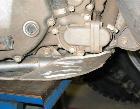
with these rocks, but the third time through I smacked the right rock hard. I thought it was the
pipe that took the hit, but it was the skid plate, which I've now confirmed is worth its weight in
water pumps.
I continued riding aggressively on the fourth and final lap. In the first part of that lap I was
surprised to see #10 Jon “Spud” Simons on a rather un-Husky-like bike. His pace was fast
enough that I would have followed him to the end, if needed, but Spud let me by and I finished
the lap with a final, very careful run through the creek. When the class results were posted, I
counted the number of races who’d finished the four laps more quickly than me. For a top-20
finish, it was going to be close. When the overall results were posted, I’d squeaked in by a
mere 12 seconds over #588 Jake Johnson in the A Intermediate class.
I give credit to Lord Kelvin.